Archive for Links: Hiking & Climbing

Sophie Slurps Snow

Review: PBS series “The National Parks: America’s Best Idea”

kenburns

DISCLAIMER: As an historian and outdoor recreation professional, I’m doubly biased here. Still, I firmly believe Ken Burns’ newest documentary series represents his best work ever.

The six-part series, “The National Parks: America’s Best Idea” covered the history of the national park service from the creation of the world’s first national park (Yellowstone, established in 1872) to the present. Today, the National Park Service includes 391 units, incorporating 58 national parks and 333 national monuments and historic sites, in 49 states (only the nation’s fist state, Delaware, lacks a National Park unit).

I was honored with the opportunity to view the entire series earlier this summer and I can honestly say, I was stunned by the depth of the document, in terms of research, reporting and production. The 12-hours of document includes remarkable photography – both historic and modern – and stunning cinematography throughout the product. The visuals are matched, though, but the details in the commentary and reporting. Burns and his colleague, historian Dayton Duncan, unveil stunning historical facts that few Americans knew about their park service and remarkable stories of individuals who help preserve these wild lands we take for granted at times today.

Washington’s Mount Rainier National Park plays a significant role in the series, as it has in the history of the Parks Service (MRNP was the nation’s 5th National Park, established in 1899). Rainier also helped refine John Muirs wilderness ethic, and played a role in crafting the wilderness passions of Stephen Mather, the first director of the new National Parks Service. You’ll also see plenty of Yellowstone NP, Yosemite NP, Glacier NP, Volcanoes NP, Olympic NP, Crater Lake NP, Grand Canyon NP, Utah’s collection of stunning parks and others. You’ll learn about the role played by the US Army in protecting and preserve the parks early in their history, and the significant role of the African American cavalry troopers, the Buffalo Soldiers, in preserving the parks, especially Yosemite, when the parks faced serious threats from developers.

The new series launches on PBS stations around the country Sunday night (September 27) at 8 p.m. I encourage everyone who reads this blog to tune in, or TIVO, this series. I guarantee you won’t be disappointed.

For more information, visit http://www.pbs.org/nationalparks/

Get Chitika eMiniMalls

Working together: Diverse group fights Bristol Bay land abuse

It’s an impressive feat, and one that bureaucratics and politicians ignore at their own risk.

A diverse group of  hunting, fishing and environmental groups, along with an array of businesses (outdoor gear manufacturers, retailers, guide services, travel companies, etc), work, teamed up to fight Bush-era rules that opened the Bristol Bay area of Alaska to hardrock mining and other exploitive uses.

The coaltion of group – numbering the hundreds – representes tens of millions of America’s conservationists,  anglers, hunters, hikers, outfitters, guides, lodge owners and outdoor industry members. Today, this group formally petitioned Interior Secretary Ken Salazar and Bureau of Land Management (BLM) Director Bob Abbey to protect from mining 1.1 million acres of federal fish and wildlife habitat near Bristol Bay, Alaska. Trout Unlimited (TU), one of the leaders of the coalition, described the Bristol Bay area as  “a large swath of BLM land near one of the world’s most productive salmon and rainbow trout fisheries.”

According to a TU press release, the letter to  Salazar  expressed deep concern that during their final days in office, Bush Administration officials finalized a plan to remove existing protections for fish and wildlife on the BLM lands and to open the area for mining. The group called on Salazar to direct Abbey to reverse that decision.

“Sport fishing in Bristol Bay is a $60 million business while commercial fishing pumps another $300 million into the economy,” said Chris Wood, Chief Operating Officer of Trout Unlimited.  “One out of four wild fish sold in America comes from Bristol Bay.  Thousands of Alaska Native families depend on the area for subsistence.  Never before have commercial fishermen, recreational anglers and subsistence users been so united on a single issue. Secretary Salazar and Director Abbey have a chance to do the right thing for Alaska Natives, commercial fishermen, and recreational anglers and hunters who come to Alaska from all over the world.”

TU’s press release continues:

The acreage under consideration has been closed to mineral development for more than three decades. In Nov. 2008, just weeks before leaving office, Bush Administration officials finalized a plan to lift the prohibition on mining. The BLM plan for its lands around Bristol Bay is especially troubling in light of a proposal to build one of the world’s largest open-pit copper and gold mines in virtually the same area. The Pebble deposit is located on state land in the headwaters of the Kvichak and Nushagak Rivers, systems that host some of the biggest runs of sockeye and king salmon left on the planet. The developers (Anglo American and Northern Dynasty) recently stated that they are months away from applying for state permits to build the giant mine. The controversial project poses the risk of acid mine drainage, a catastrophic release of mine waste, and irreparable harm from habitat alteration to the Bristol Bay watershed.

“The Pebble mine is bad enough but to have the BLM opening the door for a mining district in Bristol Bay is simply unacceptable. My business and so many others like it out here depend on the world-class salmon and trophy-sized trout that this area is famous for. You can’t have a mining district without putting these fish at serious risk,” said Brian Kraft, owner of the Alaska Sportsman’s Lodge and Bear Trail Lodge, both in the Bristol Bay region.

In addition to the threat Bristol Bay faces from proposed offshore oil and gas development and the Pebble project, the signatories to the Salazar letter maintain that opening the BLM lands to mining creates enormous potential for a development rush in the watershed. They believe the cumulative impacts to Bristol Bay over time could destroy the fishery. The group wants Salazar to maintain the mining prohibition while the BLM works to produce a better land use plan for Bristol Bay that will generate economic opportunity while conserving commercial, sport and indigenous fishing traditions for future generations.

“Director Abbey has the opportunity to protect Bristol Bay and make these biologically important federal lands permanently off-limits to mining. This fishery is too rare, too productive, and too valuable to put it at risk,” said Gary Berlin, President of the American Fly Fishing Trade Association.

FInd out more about Trout Unlimited here: www.tu.org

Get Chitika Premium

Back outdoors after a week of “outdoor” trade show

The semi-annual Outdoor Retailer trade show has wrapped up once again, and I wasted little time in throwing off the “convention center” blues by diving back into the outdoors.

After 3-days of immersion in outdoor gear, it was good to get back into the backcountry to remind myself what that show is really all about. Donna and I headed up into Mount Rainier National Park early Saturday morning. We hiking the popular trail from Mowich Lake to Spray Park then went cross country, exploring the far-flung coves of Spray Park, dropping into Mist Park and climbing up onto Hessong Rock and Mount Pleasant. A wonderfully relaxing work out in the wildflower-rich high country of Mount Rainier’s northwest corner.

A few pictures from the day can be viewed here

Washington Wildflowers coloring the Cascades

A short hike in the South Cascades today revealed an array of wildflowers in bloom.

The 2-mile trek up to the scenic and historic High Rock Lookout yielded unmatched views of the South Cascades range, from an in-your-face view of Mount Rainier, to shimmering-on-the-horizon Mount Hood. The high, rugged Goat Rocks still maintain a heavy mantle of snow, while the jagged teeth of the Tatoosh Range is nearly snow-free. Most of the trails in the central South Cascade – such as those that meander through the Dark Divide region, and rolling through Indian Heaven Wilderness, the William O. Douglas Wilderness and the routes around Mount St. Helens –  are open and generally snowfree. The Forest Service trail crews, though, note that there are plenty of downed trees blocking roads and trails throughout the region and the shortage of funds means many won’t be logged out for several weeks.

That said, the High Rock Trail was logged out today but a trail worker out the Cowlitz Ranger District. So nothing will prevent you from enjoying the on-going bloom of wildflowers on this route. What’s blooming this weekend? Here’s what I can remember:

  • Beargrass
  • Trillium
  • Glacier Lilies
  • Avalanche Lilies
  • Paintbrush
  • Lupine
  • Wild Strawberries
  • Penstemon
  • Phlox
  • Tiger lily
  • Golden Daily

Cutthroat practices in Idaho adventures

It was like a week-long flashback. Once again, I joined my brother Jim for some fishing adventures, and once again, he caught two or three fish for every one I netted. But this wasn’t the early-80s, and I was no longer in high school.

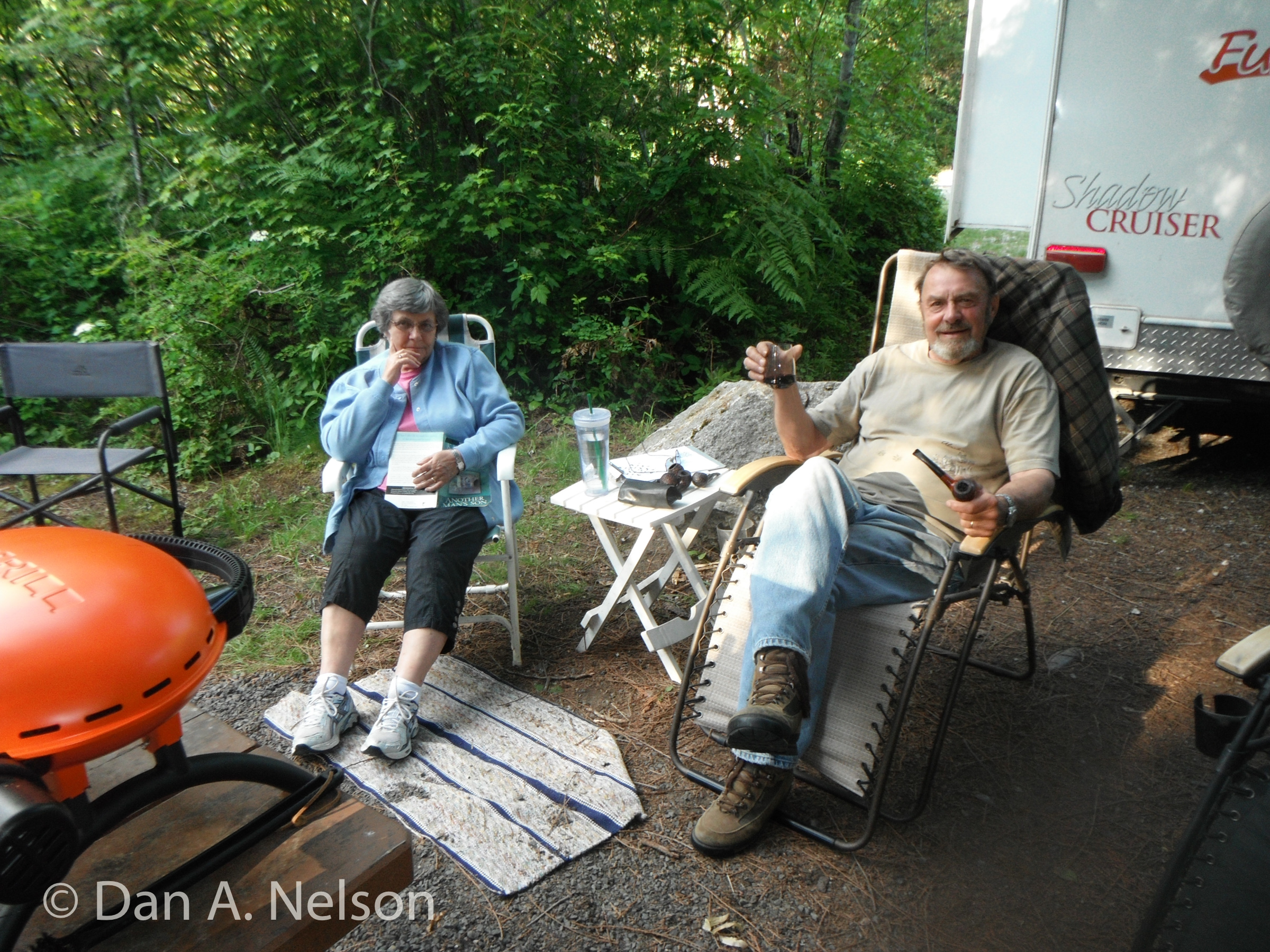
Rather than Jim and I seeking pan fish and small-mouth bass around the Lyons Ferry area of the Snake River, we were deep in the Northern Idaho mountains in search of cutthroat trout. Joining us were our spouses and our parents – out for their first tent-camping adventure in a couple decades (they long ago traded their tents for RVs, but this trip wasn’t suitable for long camping trailers).

Donna and I journeyed east to my hometown to meet up with the folks – along with their aging Sheltie, Flicka –  and then the next day we continued east into Idaho, picking up Jim and Sue – along with Duke the retriever and Jetta the lapdog – just before crossing the Idaho border at Lewiston.  Several hours later we were high up the North Fork Clearwater Valley, setting up camp near the mouth of Kelly Creek (hardly a creek as it’s flow was at least equal to the main branch of the North Fork above the junction).

After setting up camp, Jim, Donna and I rigged our rods and headed up Kelly Creek to test the waters. Even with the water level still high with spring run-off (water was lapping in the brush on the banks) the fishing was fine, if a bit slow. We found fish every day (though only Jim caught fish on the first day of full sun –and then only  in the last hole he fished after pounding the rivers all day). The fish averaged around 14-15 inches. The smallest cutthroat (one of mine) was about 9 inches and Donna had one 10-inch bull trout (caught on a dry fly – a #12 caddis). We were able to match a couple small hatches, but mostly we enticed the cutthroats with stimulators and attractors. Big, high-floating dries seemed to pull the sluggish feeders out of the depths but one fly served me better than any other – a #12 or #14 Purple Haze from the Yakima River Fly Shop. These attractors pulled scores of fish out when even perfectly matched hatches failed to draw finicky feeders out of their holes.

On day 1, we watched one thick bodied cut, about 16 inches, slowing working a deep hole just a short cast from a gravel bar. It was feeding on a small hatch of pale mayflies, which we matched perfectly. It came up and looked at Jim’s smooth presentation several time, but never took. Finally, I tried my Purple Haze and the slab-sided cut came out of the water like a starving orca, slamming the fly and flashing back into the depths. I didn’t have my camera for that fish, but it was just the first of many for the week.

While there were only a few anglers working the river, Donna and I were able to find perfect solitude on Day 3, as well as fine fishing, by hiking up the Kelly Creek Trail as it heads upstream from Moose Creek. The first 1 to 1.5 miles of trail stays well above the river, but beyond that, there are plenty of access points to fish-rich holes along the river.

We had a bit of rain the first night, fortunately well after we retired to our tents, but the next day was rainy and damp from shortly after dawn until late afternoon. The sun finally came out on Day 3 and, other than a short lightning storm around midnight, we had fine weather the rest of the stay.  After spent the last 15-20 years camping in well-outfitting trailers and pickup campers, Mom and Dad were troopers, putting up with rain, wet firewood (making campfire building a challenge) and whiny anglers who had to work hard for the fish they caught. It was a pleasure for Jim and I – as well as for Sue and Donna – to spend this time in the woods with the folks.  Dad found, cut and split stacks of firewood to keep the damp campfire burning during the week, and Mom kept the campers cheery and well feed.

None of us kept track of the total number of fish we caught, but we all acknowledged that Jim easily had twice as many trout as anyone else. Just like he did 30 years ago when he first introduced me to fishing.

GEAR REVIEW: Watch where you’re going

While some hikers favor simple, clean wristwatches that keep reliable time, others seek out the most advanced technology to wear on their wrists.HG Axio 2

We’ve previously addressed the first group (see May 21 review of the Wenger Raid Commando) and now we’re tackling the techies. An array of digital tools can be packed into wristwatches today, and after thorough testing, we’ve found a few products worth considering.

We found the Axio by Highgear to be the best choice of altimeter watches. The Axio, and its smaller sibling, the Axio Mini (designed to comfortably fit women’s wrists), features a Swiss-made altimeter (effective from 2,300 feet to 29,520 feet), a chronograph, dual altitude alarms, a hydration alarm and, of course, all the basic timepiece functionality. Whether we were snowshoeing up to Camp Muir or running up and down the hills of the Swakkane Canyon in the Columbia Basin, the Axio kept accurate track of our altitude changes. In fact, the altimeter functions proved to be the most accurate of all the units we tested, but also the least expensive. Finally, the Axio line features a stylish design that looks good in the office and performs well in the field. What more can you ask for, especially at a price of $125? More information: www.highgear.com.

timex-ws4-1For explorers who want to add a digital compass to the arsenal of features, andwho prefer to have all their travel data available on one screen, Timex offers the new Expedition WS4. This beefy wristwatch offers more data at a glance than any other watch on the market, making the WS4 a useful tool for high-altitude adventures (as you’d expect from a product designed in part by Conrad Anker). The WS4 puts an array of data on the 1.5-inch wide screen so users don’t have to toggle through menus to get all the information they need. The WS4 sports an altimeter, barometer, digital compass and chronometer. It performed well on multiple ski and snowshoe excursions around Mount Rainier and Mount Baker. Multiple alarms keep you on time and can keep track of how long you are above a set altitude (important for those who venture into the death zone). $200. See www.timex.com.

–By Dan A. Nelson, Special to The Seattle Times

Wild about Congress…

…and Congress is Wild about Wilderness!

Every once in a while, Congress does something that deserves praise.

This week, in the midst of all the angst-ridden days of dealing with the economy, the House of Representatives followed the Senate’s example, and overwhelmingly passed the Omnibus Public Land Management Act. President Obama is expected to sign the legislation without delay, putting in place one of the most important wilderness and wildlands recreation packages in this country’s history. More than 38 Republicans in the House added their support to the bill, helping it achieve an impressive 285-to-140 vote. 

Folding within the massive Omnibus bill are several pieces of that legislation that will extend and enhance the National Trails System, expand some national parks, and protect hundreds of thousands of acres of pristine wildlands as designated wilderness. (see map below).

New Designated Wildernesses

The Omnibus Bill provides Wilderness Designation to 470,000 acres in the Sierras and San Gabriel Mountains in California, as well as 517,000 acres of the Owyhee Canyon Country of Southwestern Idaho. Northern Michigan adds 11,700 acres of wilderness along the shores of Lake Superior and more than 1.2 million acres earns protected status in the Wyoming Range of the Rockies.

For us Northwesterners, in addition to protection of the stunningly beautiful and rugged canyons of the Owyhee country in Idaho, the Omnibus bill includes provisions to establish the Lewis and Clark-Mount Hood Wilderness in the Mount Hood National Forest. This new designation would protect approximately 132,000 acres of forest and alpine terrain in the Mount Hood area of Oregon. 

Several Civil War-era battlefields earn protections against development with new or enhanced status within the National Park System, and more than 1,000 miles of scenic rivers and streams around the country are shielded from commercial development, ensuring fish habitat and recreational opportunities are secured for all future generations.

Service, not sales, growing part of outdoor industry websites

Even though the outdoor industry remains relatively strong in this sluggish economy, cautious customers still need to be courted.

People seeking information about specific products are always going to seek out company websites for that product-specific information. The question is, how do you get casual browsers to visit — and stay at — your site? The longer someone surfs through a single site, they more likely they are to develop a connection with that brand.

Merrell, one of the long-time leaders in the outdoor footwear market — and now one of the more innovative designers of active apparel — offers a redesigned website this week. The flash-based site includes a lot of multi-media content. Much of it is focused on their product lines, but there is also a lot of detail about outdoor adventure activities and participants.  Their events page includes a variety of events, from the Boston Marathon, to the Big Blue Adventure (multisport race/participation event series that includes: kayaking, mountain biking, trail running, orienteering, and generation wilderness navigation.

The Merrell.com site also sports a nice visitor’s adventure blog section, so site visitors can add journal posts and photos from their own outdoor adventures.

This site is most definitely a commercial site, designed to help build the Merrell name and sell their products, but the fact that the company is adding non-commercial content is nice to see. Its a nod to the interests of their customers that extends past the contents of their wallets.

Of course, Merrell isn’t alone in this break from the normal business plan online.

Seattle’s own Outdoor Research – www.outdoorresearch.com — has long offered the Verticulture section. OR defines Verticulture as “The totality of socially transmitted behavior patterns of human powered adventurers; a predisposition to engage in the exploration of wild country, oceans to high peaks, with a variety of tools in all seasons.”  This section of the OR website is awash in adventure tools and journals. You can read about treks across the Andes, check calendars for important dates, such as the Banff Mountain Film Festival, and find detailed product reports and reviews.

Patagonia, meanwhile, offers some world class essays on public environmental activities, policies and practices.  Patagonia.com also hosts their Tinshed section, which blog section that boasts some incredible esssay, news stories, and general outdoor commentaries.

The list goes on, but the fact remains that the Outdoor Industry is leading the pack when it comes to non-commercial content for the public on commercial websites.  This is a nice trend to see.

FOOTWEAR: Light boots that fit Northwest trails

The trend toward lighter trail footwear is spreading, with some of the best new products coming from the birthplace of alpine adventures: the Alps themselves!

A couple new products, from companies based in the Alps, proved themselves worthy of Northwest hikers after we pounded trails around Washington while wearing them. From the ash-laden tracks on Mount St. Helens to the alpine fields of Schreiber’s Meadows on the flank of Mount Baker, we put these shoes to the test.

La Sportiva, based in the Italian Alps, offers the Sandstone GTX for wet-weather hikers. This rugged low-top hiking shoe features a stout midsole and Vibram outsole that provides great foot protection on rough trails, as well as firm grip on all trail surfaces, from rock and sand to mud and snow. The Gore-Tex XCR liner keeps your feet dry when slogging through slop, while a wide gusseted tongue prevents trail debris from sliding inside.

These are among the stoutest low hikers we’ve tested, and we found them suitable for day hiking or even light backpacking — we felt secure with packs weighing up to 30 pounds. The La Sportiva Sandstone GTX, available in men’s and women’s sizes, sells for $125. Information: www.lasportiva.com.

Wenger, one of the Swiss Army-brand companies (known for pocket knives), recently entered the footwear market and one of its inaugural shoes is ideal for Northwest trails. The Wenger Interlaken is a leather and mesh midheight trail shoe. Lightly padded cuffs reach just above the ankle to provide strong lateral support when carrying full day packs while a textured rubber outsole is soft enough to smear onto rocks for secure scrambling and even light bouldering. The single-pull locking lace system makes it easy to secure the boots and the stretch-mesh construction molds to your foot like a rock-climbing bootee.

The lightweight design as well as the soft rubber outsoles make these trail shoes incredibly comfortable, yet they do lack durability. Still, if you need comfortable support for scrambling up rocky trails, the Interlakens are hard to beat. They sell for $110. More information: www.wengerfootwear.com.

– Dan A. Nelson, for The Seattle Times